
Patellar Tendonitis
Chronic patellar tendon pain at the front of the knee. An overuse condition that responds to progressive loading and targeted tissue therapy.

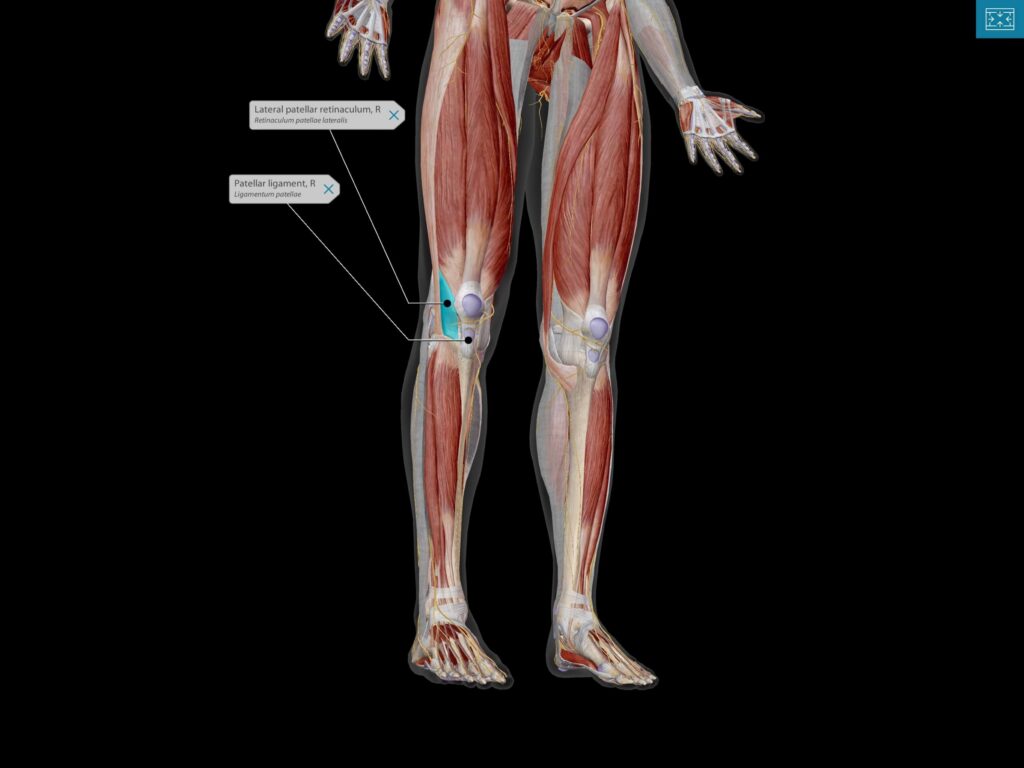
What Is Patellar Tendonitis?
Patellar tendonitis refers to pain and dysfunction in the patellar tendon, the strong band of tissue that connects the kneecap (patella) to the shinbone (tibia). When the condition becomes chronic, the term patellar tendinopathy is more accurate, because the tissue changes are degenerative rather than inflammatory.
At Function Performance Sport Chiropractic in Oregon City, we treat patellar tendonitis with an evidence-based approach that combines progressive tendon loading, advanced modalities like focused shockwave therapy, and full-chain assessment to identify everything contributing to the problem.
Most chronic patellar tendon pain does not respond well to rest or generic stretching alone. The tendon needs progressive loading to restructure the damaged tissue and build capacity. Our approach combines that loading with targeted manual therapy, advanced modalities like shockwave for stubborn cases, and full-chain assessment to identify factors upstream and downstream that contribute to the problem.
Rest Does Not Fix Tendinopathy
Chronic tendon pain requires loading, not rest. We build a progressive plan that restores tendon capacity and resolves the symptoms.
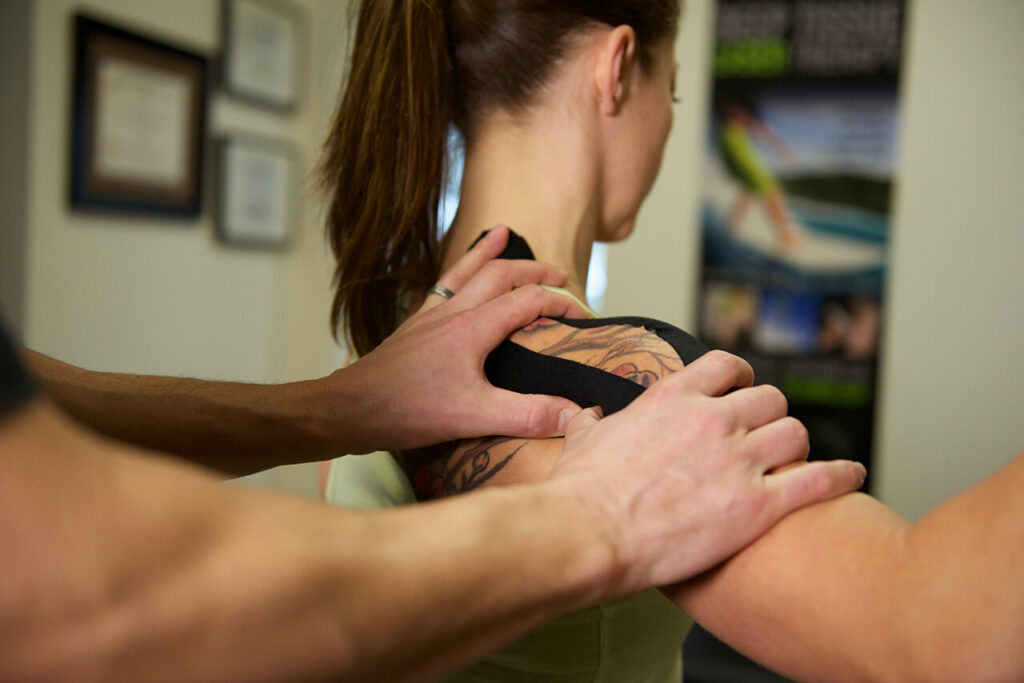
Restoring Capacity: Our Approach to Patellar Tendonitis
The Key Insight About Tendon Pain
One of the most important things to understand about chronic patellar tendon pain is that rest alone does not typically resolve it. In fact, true complete rest often makes the condition worse by allowing the tendon to lose capacity without addressing the underlying tissue changes.
What actually resolves chronic tendinopathy is progressive loading. The tendon needs structured, appropriate stress to stimulate tissue remodeling and rebuild capacity. When that loading is done correctly, the tendon becomes stronger and more resilient than it was before the problem started.
Who Gets This Condition
Patellar tendinopathy can develop in anyone who loads the knee repetitively, but it is particularly common in:
-
- Active adults who exercise regularly (cycling, lifting, running, hiking)
-
- Recreational and competitive athletes in jumping sports
-
- Workers whose jobs involve repeated squatting, kneeling, or heavy lifting
-
- People returning to activity after extended rest or injury
-
- Middle-aged adults with a history of activity and intermittent flare-ups
For athletes specifically in jumping sports (basketball, volleyball), we treat this as jumper’s knee with sport-specific considerations.
Contributing Factors
Patellar tendinopathy does not typically develop from a single cause. Multiple factors usually contribute:
-
- Activity load that exceeded tissue capacity at some point
-
- Poor quadriceps function (weakness or inhibition)
-
- Hip strength and control deficits that amplify knee loading
-
- Ankle mobility restrictions that shift load to the knee
-
- Patellofemoral tracking issues that stress the tendon
-
- Insufficient recovery time between demanding sessions
Addressing all of these factors produces more durable results than treating only the tendon.
Our Treatment Approach
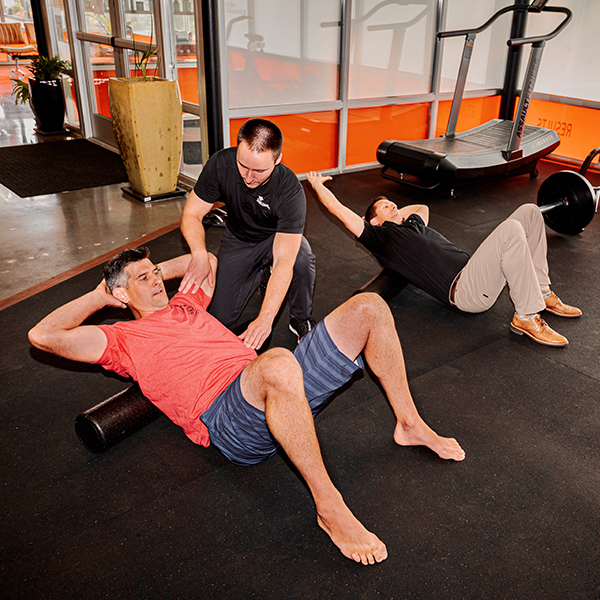
Stage-appropriate loading. We match the loading protocol to your specific stage:
-
- Isometric loading for pain relief in early or reactive stages
-
- Heavy slow resistance training for tendon remodeling in chronic stages
-
- Progressive plyometric and activity-specific loading as the tissue builds capacity
-
- Advanced loading progressions for return to demanding sport or work
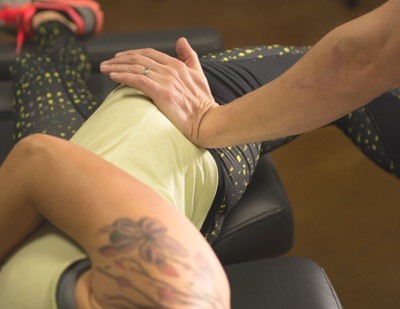
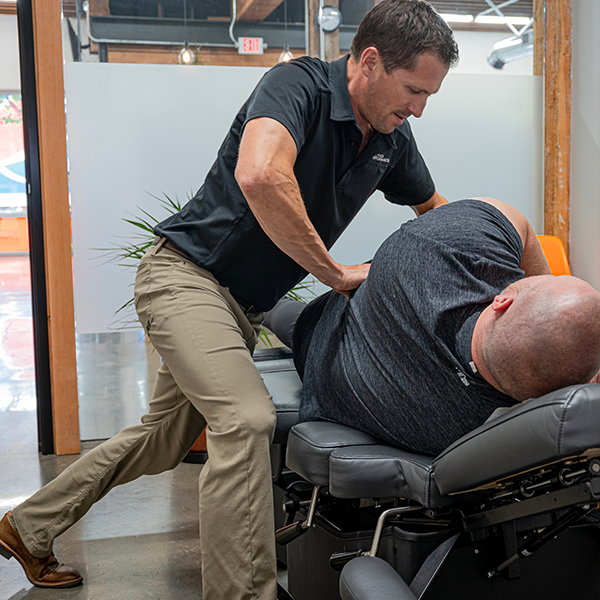
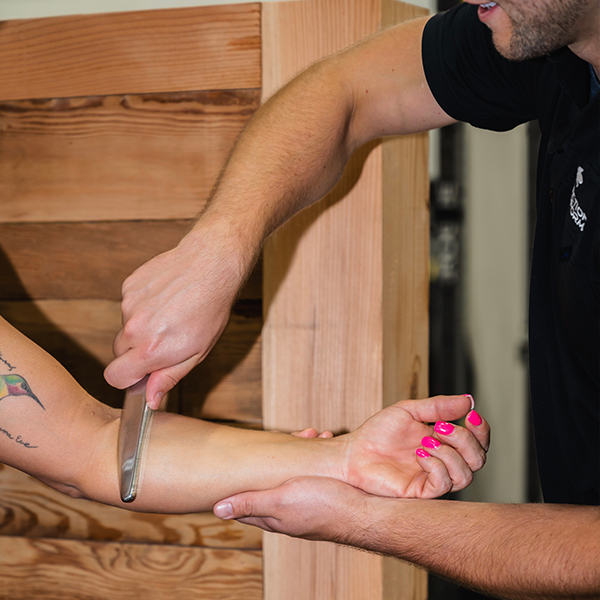
Manual therapy. Precise soft tissue work on the quadriceps, IT band, and surrounding tissue. Joint mobilization of the patellofemoral and tibiofemoral joints. Cupping and IASTM for chronic tissue restrictions.
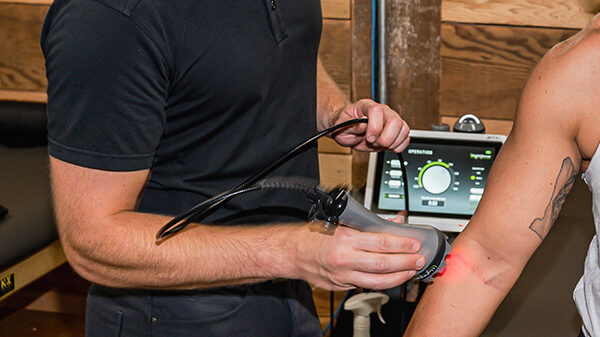
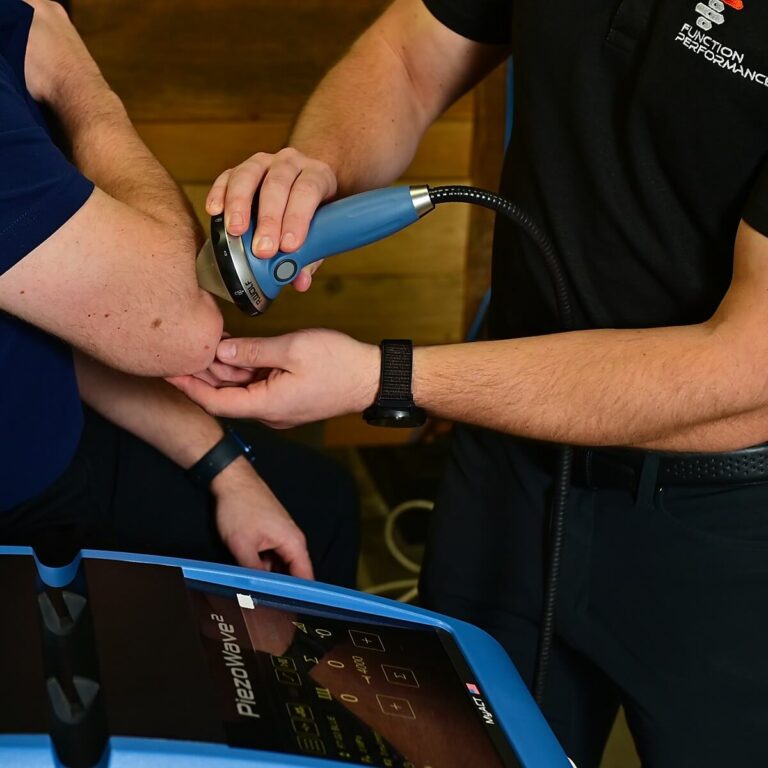
Focused shockwave therapy. For chronic cases that have not responded to loading alone, shockwave is one of the most evidence-supported tools available. It often produces significant change within three to six sessions and integrates well into a progressive loading plan.
Class 4 laser therapy. Supports tissue healing and reduces pain during the active rehabilitation phase.
Full-chain work. Hip strengthening, glute activation, ankle mobility work, and movement retraining. The knee does not exist in isolation, and addressing the full kinetic chain dramatically improves outcomes.
Honest Recovery Timelines
Most cases of patellar tendinopathy show meaningful improvement within four to twelve weeks of integrated care. Highly chronic cases that have been present for a year or more may take longer, but respond well to the right combination of loading and shockwave. Throughout, objective markers (pain-free squat depth, single leg strength, functional testing) track progress clearly.
Book your performance evaluation today to start with a thorough assessment and an evidence-based plan for your patellar tendonitis.
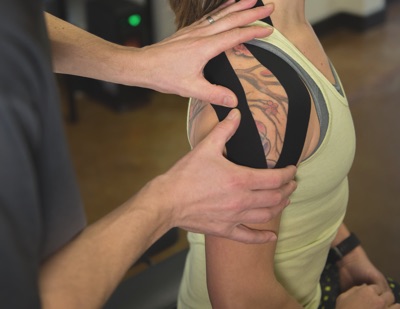
How we Treat Patellar Tendonitis
Explore a full range of evidence-informed therapies designed to
reduce pain, restore movement, and support long-term recovery.

Common Symptoms You May Be Feeling
Patellar tendinopathy produces distinct patterns. If these match your experience, targeted care is the right next step.
Book Your Performance Evaluation Today
Dealing with persistent knee pain at the front of the knee? Start with a thorough assessment and get a plan built for chronic tendinopathy.
Common Questions
Usually not completely. Total rest often makes tendinopathy worse by reducing tendon capacity. Modified activity that keeps some load on the tendon, combined with structured rehab loading, produces better results than complete rest.
Most cases become chronic when the tendon is either under-loaded (true rest, leading to degenerative changes) or over-loaded (continuing full activity without addressing the underlying issues). Progressive loading at the right intensity is what breaks the cycle.
Functionally, yes. Jumper’s knee is the sport-specific term for patellar tendinopathy in athletes whose sports involve heavy jumping and cutting. The pathology is the same, though the context and return-to-sport demands may differ.
Most chronic patellar tendinopathies show meaningful improvement within four to twelve weeks of integrated care. Severely chronic cases may take longer, but significant progress should be measurable throughout. Shockwave often accelerates the timeline in stubborn cases.
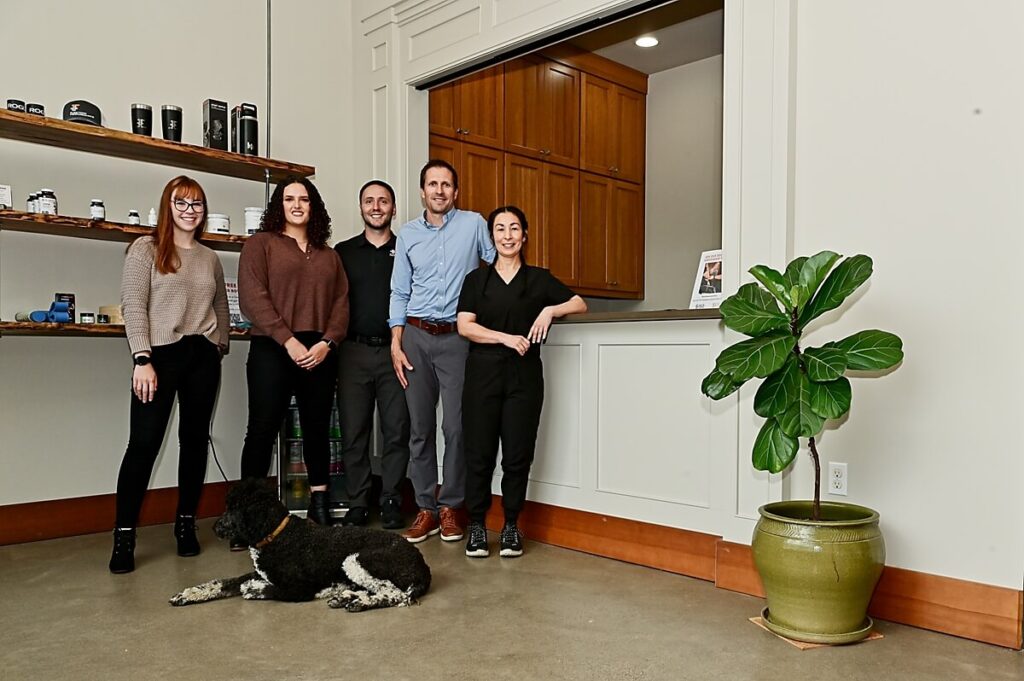
Meet the Team
Our Chiropractic Sports Physicians combine advanced soft tissue training with progressive rehab so you move better, perform better, and live better.
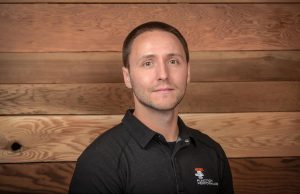
Ben Hokenson DC, DACBSP
Chiropractor
Meet Ben →Dr. Ben is a 2008 graduate of University of Western states earning his doctorate of chiropractic degree with many years of clinical practice and continual training.

Kyle Bangs DC, MS, CCSP, CSCS
Chiropractor
Meet Kyle →Dr. Kyle Bangs is a native to the Pacific Northwest — growing up hiking, fishing and staying active with various sports and recreation in SW Washington.
Certifications and Therapy









Why Choose Function Performance?
Progressive Loading Expertise
Our providers understand tendon rehabilitation in depth. We design and progress loading programs specific to the type and stage of tendinopathy you have.
Advanced Modalities
Focused shockwave therapy and Class 4 laser support tissue healing in tendinopathy cases that have not responded to loading alone.
Full-Chain Assessment
Hip weakness, ankle restrictions, and quad imbalances all amplify patellar tendon load. We address every contributing factor, not just the painful tendon.

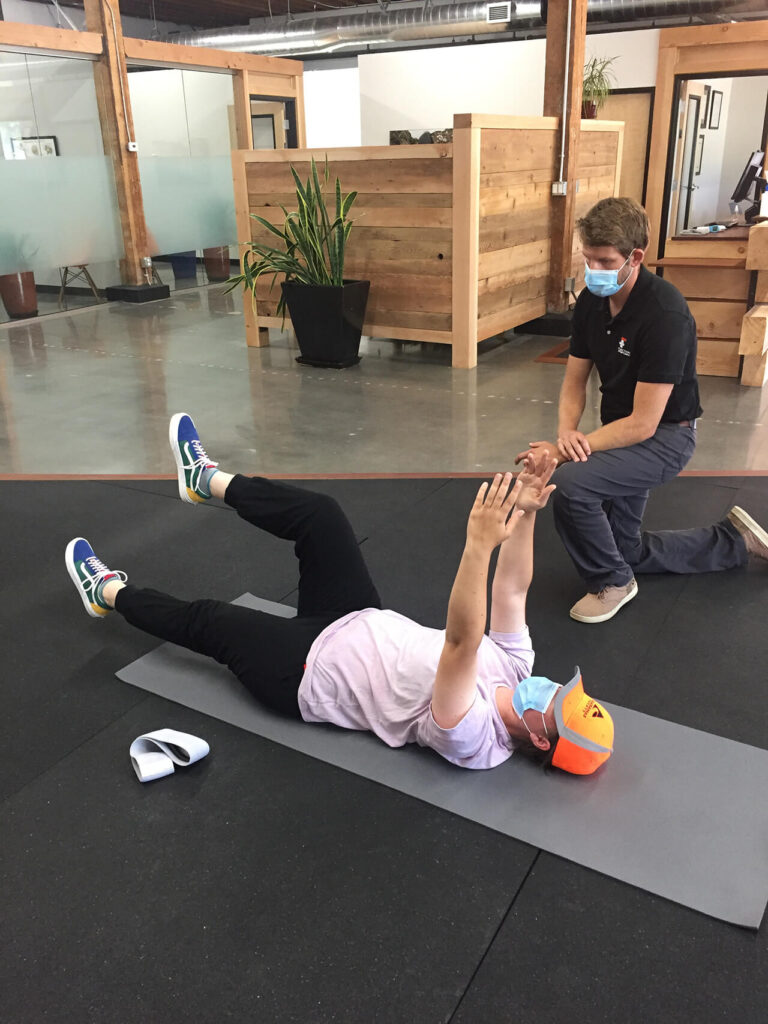
We don’t do cookie-cutter massage. We tailor everything to you.




